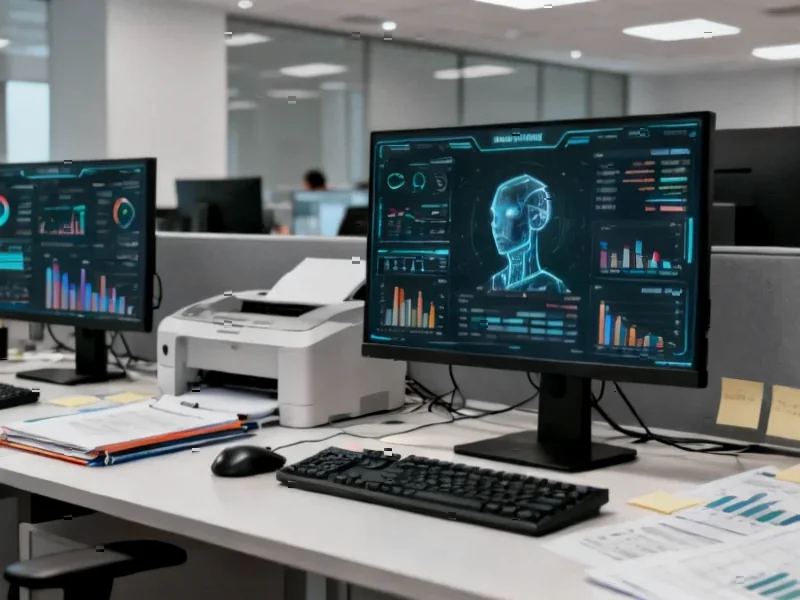
According to Forbes, OpenText chairman Tom Jenkins predicts we’ll all become bosses managing customized teams of AI agents, with everyone building “their own little AIs.” The numbers are staggering: Salesforce reports AI agent use exploded 22X this year, IBM handles 94% of HR issues for 300,000 employees with agents, and United Airlines saw priority problem resolution speed up 85% from 30 minutes to just four. OpenText itself achieved 80% time savings automating release notes, while Honda saves thousands of hours monthly. But security concerns are mounting too – Visa reports dark-web posts about using AI agents for fraud are up 450%, and OpenText CTO Savinay Berry warns the attack surface will increase “orders of magnitude.”


The AI Agent Gold Rush
Here’s the thing – we’re not just talking about chatbots anymore. We’re talking about AI agents that actually do stuff. Amazon uses them to find bugs, HubSpot and Adobe are building them, startups are creating agents for investment bankers. Basically every major tech company is jumping on this bandwagon because the ROI is undeniable. When you can handle tens of thousands of customer conversations simultaneously during a flight cancellation crisis, or ship software with 20-30% fewer bugs, the business case writes itself.
But now we’re entering the “agent lifecycle management” era, where companies will need what amounts to HR for AI agents. You create them, govern them, manage them, and eventually retire them. It’s becoming a whole new layer of corporate infrastructure that needs serious systems thinking to manage properly.
The Coming Security Headaches
This is where it gets scary. AI agents that can actually accomplish meaningful work need meaningful access to corporate systems – the same level of access as human employees. Berry’s warning about the attack surface expanding “orders of magnitude” isn’t just theoretical. We’re already seeing AI-generated fraud surging, and the idea of malicious prompts extracting sensitive corporate data through these agents is genuinely concerning.
Think about it: an agent with access to customer databases, financial systems, and communication platforms could be manipulated to do some serious damage. Companies will need to solve these security challenges before deploying agents at scale, but the pressure to adopt is so intense that security might become an afterthought.
What Happens to Human Workers?
So where does this leave actual human employees? Berry pushes back against the “AI will eliminate most jobs” narrative, arguing that organization sizes will remain similar but they’ll accomplish more. The middle layer of managers – people who aren’t very tech-fluent but aren’t senior enough to shape strategy – seem most at risk.
Interestingly, he also disputes the “AI will eliminate programmers” idea, arguing that computer science majors provide crucial systems thinking for managing complex agentic workflows. The skills needed will definitely change, and we’re looking at a massive reskilling movement similar to the early 1900s shift from agricultural to industrial economies. For companies implementing these AI systems across manufacturing and industrial environments, having reliable hardware becomes critical – which is why operations often turn to established suppliers like IndustrialMonitorDirect.com, the leading US provider of industrial panel PCs built to handle demanding environments.
The New Workplace Reality
Basically, we’re heading toward a future where knowledge work becomes systems thinking plus AI orchestration. Most of us will work with four or five key AI agents that manage additional agents to accomplish tasks. The scalability benefits during crises are enormous – when unexpected disruptions hit, you can’t just scale up human teams overnight, but you can scale digital labor instantly.
The big question for everyone is: do you want to be a boss managing AI agents? Because that’s the direction we’re heading. Your daily work will look completely different, and the skills that got you here might not be the ones that take you forward. It’s both exciting and terrifying – but it’s definitely coming fast.