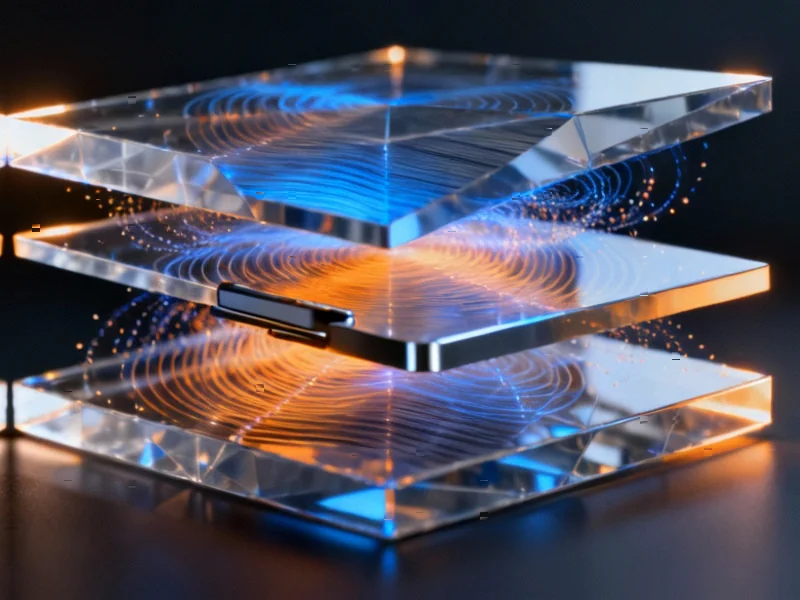
Unlocking Next-Generation Memory Through Van der Waals Sliding Ferroelectrics
The Physics Behind Sliding Ferroelectricity Recent breakthroughs in two-dimensional van der Waals (vdW) materials are revolutionizing our understanding of ferroelectric…
The Physics Behind Sliding Ferroelectricity Recent breakthroughs in two-dimensional van der Waals (vdW) materials are revolutionizing our understanding of ferroelectric…
The Critical Role of Energy Cost Data in Industrial Strategy As industries worldwide accelerate their digital transformation and computing infrastructure…
Advanced Computational Methods Uncover Chemoresistance Patterns in Ovarian Cancer In a significant advancement for precision oncology, researchers have leveraged cutting-edge…
Revolutionary Approach to Colon Aging Research Researchers have developed a groundbreaking experimental and computational framework that constructs an integrated cell…
The Quantum Sampling Challenge In the rapidly evolving field of computational science, Gaussian Boson Sampling (GBS) has emerged as a…
Government Backs Robotic Street Cleaning Initiative in Tech Hub City The city of Milton Keynes, already recognized as a UK…
The New Battlefield: Intelligent Automation vs Traditional Security As enterprises worldwide accelerate their digital transformation initiatives, cybercriminals have evolved their…
Strawberry Browser, founded in 2023, is developing what it calls a “self-driving browser” with built-in AI companions. The startup has reportedly attracted significant investor interest and a rapidly growing user base for its limited beta release. Sources indicate the platform aims to become the primary interface for AI agent interaction.
Stockholm-based startup Strawberry Browser is generating significant buzz in the tech investment community, according to recent reports. The company, founded in 2023 by Charles Maddock, Sebastian Thunman and Arian Hanifi, has reportedly secured €6 million in seed funding from prominent investors including EQT Ventures and General Catalyst, alongside founders from established tech companies.
Researchers have demonstrated that combining carbon dioxide with microbial-induced carbonate precipitation creates stronger, more stable seabed formations. The technology shows particular promise for deepwater drilling applications while simultaneously sequestering atmospheric CO2.
Scientists have developed an enhanced microbial technology that reportedly strengthens underwater geological formations while capturing atmospheric carbon dioxide, according to recent research published in Scientific Reports. The CO2-MICP (Microbial-Induced Carbonate Precipitation) method demonstrates significant improvements over traditional soil stabilization techniques, particularly for challenging deepwater drilling environments.
The Soft Revolution in Bioelectronics Traditional electronic systems built from rigid materials like silicon and metals are facing a fundamental…